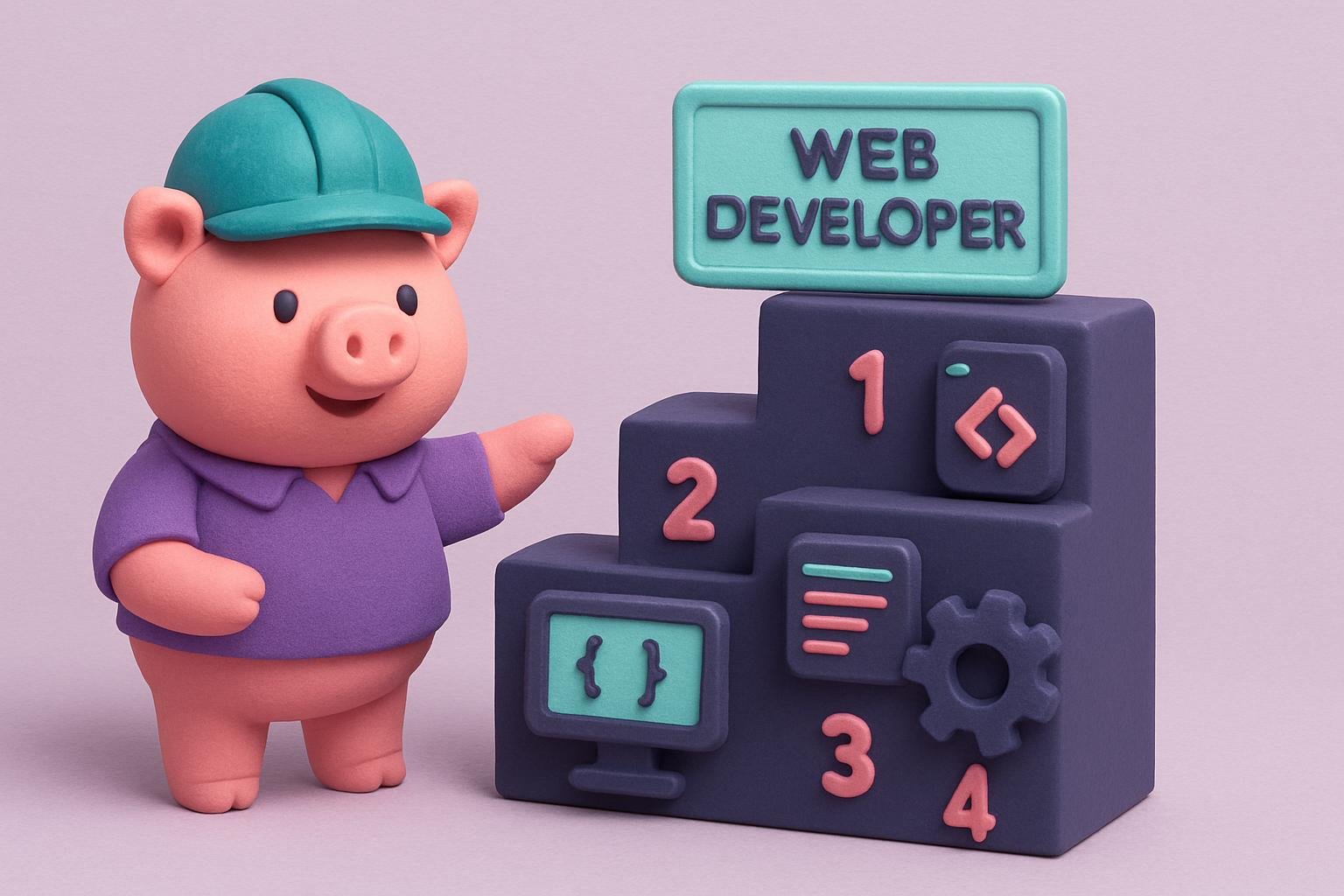
In this article, we’ll look at the steps you need to take to become a web developer and build your career in the field. We’ll discuss different learning methods, the skills that matter for web developers, and the educational opportunities you’ll need to enter the field. By taking a few key steps, you can start moving toward a new, in-demand career with excellent growth potential.
Put simply: education is the key to changing your career.
There are several formal education paths open to aspiring web developers, as well as self-guided routes you can follow on your own. Read on to learn more about the steps you need to take to become a web developer!
1. Start your learning journey
Education is of paramount importance. The first step toward success in web development should be learning the core programming technologies.
That said, you don’t have to begin your academic studies with formal education. Using online resources and watching tutorial videos can help you build a basic understanding of web development fundamentals and figure out what you want to study.
But before we get into learning paths, let’s start with some of the most important skills to learn when considering a career in web development. Take a look at our list:
HTML and CSS
HTML and CSS are often called the building blocks of any website. HTML, or Hypertext Markup Language, organizes a website’s structure and determines what a site user encounters when they visit a page.
CSS, or Cascading Style Sheets, on the other hand, determines the style and appearance of that information. Even the simplest websites use HTML and CSS, and they provide the foundation for more advanced technologies you’ll need to learn as you plan your career.
jаvascript
This scripting language lets you create dynamic, interactive websites that don’t just display static information but also respond to the needs of your clients and visitors (for example, with buttons, forms, animations, and so on).
Alongside HTML and CSS, jаvascript is one of the most widely used technologies on the web today. As you improve your jаvascript skills, you’ll want to learn libraries such as jQuery, which many interactive web applications are built on.
PHP
If you want to develop sites, themes, or plugins for popular content management systems such as WordPress, PHP knowledge is essential to your career as a web developer. Many popular websites and content management systems use PHP extensively for scripting, or writing code that performs tasks.
Because its syntax borrows heavily from other common programming languages, PHP is generally an easy language for programmers to learn.
Bootstrap and development frameworks
The more you learn, the more you’ll want to think about your specialization. If you plan to become a front-end developer and manage the part of a site that users interact with, learning how to navigate Bootstrap and similar development frameworks will be a necessary part of your education.
For context, Bootstrap is a free, open-source platform that helps developers build fast, responsive, mobile-optimized websites. It’s one of countless development frameworks that make it easier for programmers to build software for a specific platform.
Python, Java, and other programming languages
On the other hand, if you want to become a back-end developer—a professional who primarily works on the behind-the-scenes code visitors never see—learning server-side languages is a must. Some of the same programming languages used to build desktop applications are also widely used in web development; however, others are specific to back-end coding.
At a minimum, an aspiring programmer should have experience with Python and Java. Still, there are many more technologies to learn, from database languages such as MySQL to the wide range of popular development libraries available through React or Node.js.
As you move beyond learning basic definitions and skills, you may need more structured web development training. It can be difficult—if not impossible—for aspiring programmers to acquire the skills above without help or guidance. Which brings us to the next topic: education paths.
2. Get an education in web development
Getting a quality education is one of the most important steps toward becoming a professional web developer. Still, how you get that education can vary depending on your current career status, family responsibilities, work schedule, and current level of knowledge and experience.
For example, someone who needs to support their family may not have the money or time to take several years off to earn a traditional college degree. Likewise, a professional who already has some relevant skills or experience may prefer to learn independently or enroll in a short, intensive training course to upskill for a new career.
It’s important to note that college isn’t always necessary to get started. According to the Stack Overflow Developer Survey for 2020, only 9,7% of professional developers consider formal education extremely important, while more than a third (39,5%) consider it somewhat important or not important at all.
Coding bootcamps and self-study offer two alternative paths into the tech industry.
Coding bootcamps
Online coding bootcamps can be a great resource for people who value flexibility and want to upskill quickly. At a bootcamp, students focus more on the web development skills employers are looking for, compared with the more theoretical approach typically offered by college curricula.
Bootcamps focus on teaching basic and intermediate web development skills. Many bootcamp curricula are geared toward a specific area (i.e., front-end, back-end, full stack). Still, you can expect to leave a full-fledged web development bootcamp with job-ready coding knowledge and a well-stocked professional portfolio.
Full-stack bootcamps are complete, structured programs that provide expert instructors, one-on-one support, and a live learning environment. They’re especially appealing because of their flexibility; besides being much cheaper than a four-year degree, many offer part-time, weekend, and evening schedule options that can be completed in just three to six months.
Self-study
These days, information is just a few clicks away. There are plenty of online options, both free and paid, where you can enroll in a formal class, watch tutorial videos, complete projects, or even watch recorded computer science lectures. These programs are generally entirely self-paced: you set your own schedule, study the material when you have time, and work through the resources provided at your own pace.
Some free online resources provide hands-on programming experience by connecting students with nonprofit projects. You can also read programming books to expand your theoretical knowledge. In fact, these resources can be a great supplement even if you’re following a more structured, formal education program.
College or university
All that said, we’d be remiss if we didn’t emphasize the value higher education offers to those with the time and resources to pursue it. College degrees are comprehensive; they give students a broad knowledge base and plenty of project-based learning opportunities. They also tend to be well-connected, offering motivated students networking and internship opportunities.
Your education should fit your needs and circumstances—so think carefully before choosing an academic path!
3. Choose your development specialization
Generally speaking, most developers fall into one of three categories: front-end, back-end, and full-stack.
Front-end development
If you work in front-end development, you manage the user experience for people who visit a website. Front-end developers are experts in CSS, HTML, and jаvascript, and can build code that brings website design ideas to life. Your tools determine how users interact with a website; if you enjoy the creative, visual side of web development, a front-end career could be a great option for you.
Back-end development
Back-end developers design, maintain, and improve the technologies that power websites behind the scenes. Back-end developers use languages such as Python, PHP, Ruby on Rails, and Java to build applications, manage server-side technologies, and work with front-end code to create faster, more responsive website interactions.
Full-stack development
You don’t have to choose between front-end and back-end programming. If you have strong abilities and an interest in both aspects of web development, you can pursue a career as a full-stack developer. These professionals know all aspects of the web development process, from writing server-side code to managing the user interface.
This path can also appeal to people making a career change who don’t want to limit themselves early in the educational process. For this reason, many coding bootcamps provide a full-stack skill set, giving you a solid foundation in most core areas of development.
4. Build your personal web development portfolio
When it comes to building a successful career in web development, you need a strong portfolio to share with potential employers and clients.
When you attend a structured education program, such as a four-year degree program or a web development bootcamp, you’ll naturally be assigned several projects. This helps you learn through hands-on practice and ensures you graduate with a portfolio that highlights your skills and experience with a wide range of industry technologies.
You can keep adding to your portfolio with projects you build at home or in a bootcamp environment. Even small programs you create as a hobby can become part of your portfolio.
It’s worth noting that not all relevant skills are directly related to programming languages or technologies. Soft skills, such as teamwork, are essential in many technical professions, for example.