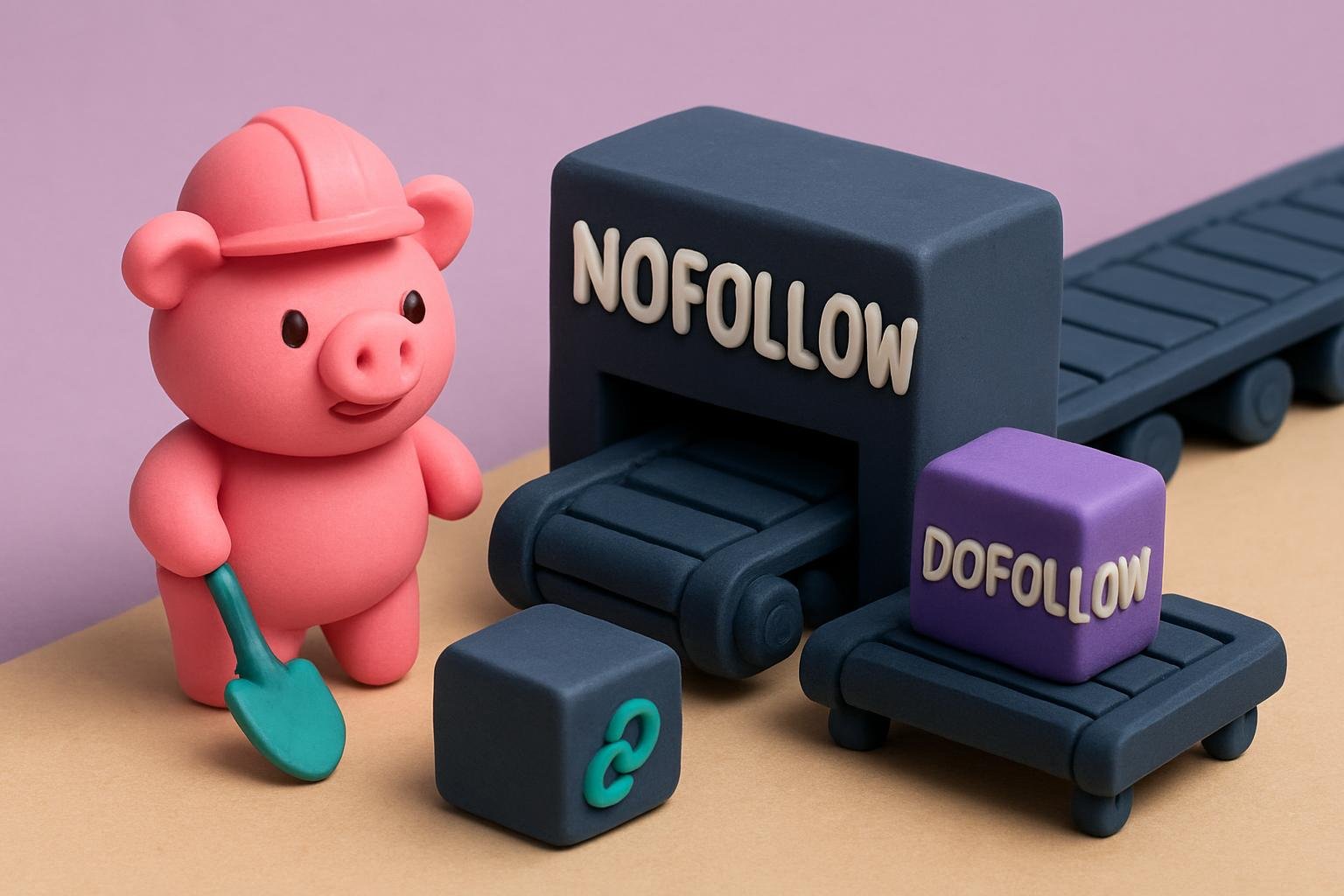
If you're looking for link builders, you rarely hear anyone mention building NoFollow links.
The reason is that backlinks are one of the key ranking factors for search engines. If you want great SEO results and higher search rankings, you need link building to boost your webpage's signals, and, generally speaking, Nofollow links don't really do that.
There are two types of backlinks: dofollow links and nofollow links.
Between these two types, dofollow links are much more valuable than nofollow links for boosting our website's authority so it can compete with other websites in search rankings. This is because, as their names suggest, dofollow links are followed and taken into account by search engines, while nofollow links are not.
So, should we get only dofollow links for our websites and completely ignore nofollow links?
The simple answer is no. Although nofollow links don't seem very useful for promoting our website to the top of search engine rankings, they can still help our SEO efforts in their own way.
What are NOFOLLOW links?
Nofollow links are links with a rel="nofollow" attribute in the a tag. When writing raw code, a nofollow link looks like this.
The nofollow attribute was first introduced by Google in 2005 so webmasters could tell search engines not to count a link as a ranking factor. It's usually used for paid links or links whose content isn't endorsed by webmasters.
In 2019, Google introduced two other rel attributes that have the same effect as nofollow links (so search engines don't take them into account when determining rankings). These rel attributes are:
- “sponsored”: a rel attribute for links involving monetary compensation for webmasters.
- “ugc”: a rel attribute for links created by users of a website.
Nofollow links with these three rel attributes matter only to search engines. To site visitors, nofollow links are no different from regular links (dofollow).
NOFOLLOW vs. DOFOLLOW links
As mentioned earlier, the main difference between nofollow and dofollow links is how search engines see them.
Search engines don't treat nofollow links as a vote of confidence in a website, but they do count dofollow links. So, if you want to boost a website's authority in SEO, the direct way to do it is to get as many high-quality dofollow links as possible.
Also, in its code, a dofollow link doesn't have a rel="nofollow", "sponsored" or "ugc" attribute in its tag.
This means that unless webmasters specifically modify the link they give to a website (by adding one of the nofollow rel attributes), the link should be dofollow by default.
If you need to determine whether a link is nofollow or dofollow, you can easily do so in your browser. For example, if you use Google Chrome, just right-click the link you want to identify and click “Inspect.”
A panel showing the code that creates the website page should appear in your Google Chrome browser. The link tag should be highlighted there. From there, you can see whether the link is nofollow or dofollow.
If the link's a tag contains a rel="nofollow", "sponsored" or "ugc" attribute, it's a nofollow link. Otherwise, it's a dofollow link.
Why are NOFOLLOW links so important for your SEO?
If search engines themselves seem to ignore nofollow links as a ranking factor, shouldn't we ignore them too when trying to do SEO on our website? Wouldn't it be better to care only about dofollow links if our goal is to reach the top of the search engine results pages?
While this is true to some extent, and our main focus in SEO should be getting dofollow links, we shouldn't simply ignore opportunities to get high-quality nofollow links when they come our way. Want to know why? Here are some reasons they can also help us improve our SEO results.
A source of referral traffic
A nofollow link from a good website with a lot of traffic may be just what we need to boost our website's overall traffic. Many people who visit that good website may be interested in clicking through to our website.
link. Because of this, we may have another source of significant traffic besides search engines.
This traffic boost can also have a positive effect on our SEO. If people find our content excellent, they may share it, which can increase awareness of our website's brand.
As a result, more people may search for terms related to our brand. What's more, if the content goes viral, it should bring in many more visitors from search engines and social media.
A source of potential DOFOLLOW links
If the people who click nofollow links are webmasters, they may be interested in sharing our content on their website if they find it interesting. The link they give when sharing our content should be a dofollow link, since it happens naturally and webmasters appreciate the quality of our content. This makes nofollow links a potential source of additional dofollow links for our website.
As we know, dofollow links seem to be the links search engines take into account when measuring a website's authority and its content. Thus, nofollow links may indirectly affect our chances of ranking high on search engine results pages.
What's more, dofollow links should appear without any effort on our part as long as the page with nofollow links to us continues to attract visitors. This should make it easier for us to improve our SEO results over time.
Improved CTR for our website
As more people come to our website through nofollow links, more people should appreciate the content on our website if it's high quality. So, when they find a link to our website through search engines, they should be more willing to click on it. This means our website's CTR on search engine results pages may also improve.
A high CTR will let you get more organic traffic from search engines. What's more, a high CTR for a link to your website may tell search engines that users prefer your website's content. Thus, it may also have a positive effect on your rankings.
Improved content quality
Traffic coming from nofollow links lets you gather more data related to your site's content. You should get a better understanding of whether people spend a lot of time enjoying your content, or whether they go on to explore other pages on your website or your offers after they finish reading it. Because of this, you should get more feedback to improve your content quality thanks to the visitors you get from nofollow links.
Properly processed and evaluated data should make your content more interesting and enjoyable for search engine users. Since Rankbrain, which sends user-experience signals to Google, is also an important ranking factor, improving your content quality should boost its search engine rankings.
The possibility that NOFOLLOW links are also taken into account by search engines
Google's official position is that they don't count nofollow links as a factor in determining their rankings.
Nevertheless, some SEO practitioners have challenged this. They say that nofollow links may actually be counted by search engines, and that the official position is intended only to discourage people from abusing these links.
Evidence for this argument comes from research and case studies conducted by several curious SEO practitioners (for example, this one, compiled on Semrush). Whether to believe it or not is up to you. Still, you should know that there's a possibility that nofollow links directly affect your site's search rankings. It would be better not to ignore them completely if you want to get links that improve your SEO results right away.
Also, search engines may take nofollow links into account in such a way that a website with only dofollow links raises a red flag because it looks like an unnatural backlink profile. It may be wise to keep this in mind when you carry out the link-building process for your website.
Now that we know nofollow links can benefit our website and its search optimization results, we could consider acquiring them to improve our backlink profile. However, to get the most out of nofollow links, we should try to get only high-quality nofollow links for our website.
What makes a nofollow link high quality?
Here are some criteria you may want to use, based on the benefits we can get from a nofollow link.
- The nofollow link should be from a well-maintained website.
- The nofollow link should come from a website page that gets a lot of consistent traffic.
- The nofollow link should come from a website in the same niche as ours.
- The nofollow link should fit the context in which it's placed in the content.
- The nofollow link should be as close to the top of the content as possible.
Getting a nofollow link that meets these criteria can help your SEO results and your website's overall growth.