Since our geographical dispersion has now become a fact of life, it would be good for us to find ways to satisfy this Agile Manifesto principle (and others) in a remote world. It’s fair to assume that remote work may have some advantages we otherwise wouldn’t have discovered. So let’s make the most of our own situation.
Take the daily Scrum, for example. It’s the only Scrum event that recurs throughout a sprint. If we want to thrive in a remote world, it’s important to make the most of the team’s time in this daily event.
Here are 7 tips for running highly effective remote daily Scrums.
Find a time that works for everyone
This has always been good advice for teams, but it becomes crucial when your teams are geographically dispersed. Take your team members’ time zones into account and find an overlapping time that works for everyone without causing too much pain for any one group. If you have members scattered across very different time zones, see if you can “share the pain,” with each group giving a little so that one group doesn’t have to give a lot. If one location can stay a little later and another can arrive a little earlier, everyone makes the same sacrifice, so no part of your team feels like second-class citizens.
Remember, it’s only 15 minutes. This meeting requires time for collaboration, so finding even a small overlap can greatly improve the team’s ability to communicate.
Leave extra time for personal conversation
In a virtualized world, we can all feel more isolated and cut off from the other people we work with every day. People naturally trust each other more and work better together when we see our colleagues as people. So set aside an extra 5 minutes for the daily Scrum, to use at the beginning of the meeting. Tell everyone to show up 5 minutes before the daily Scrum so you can keep up the typical watercooler talk in a virtual setting.
Talk about anything: a show you watched last night, sports results, your pets, or what’s going on in your family. A little non-work connection helps employees feel less isolated when working from home.
Turn on your cameras
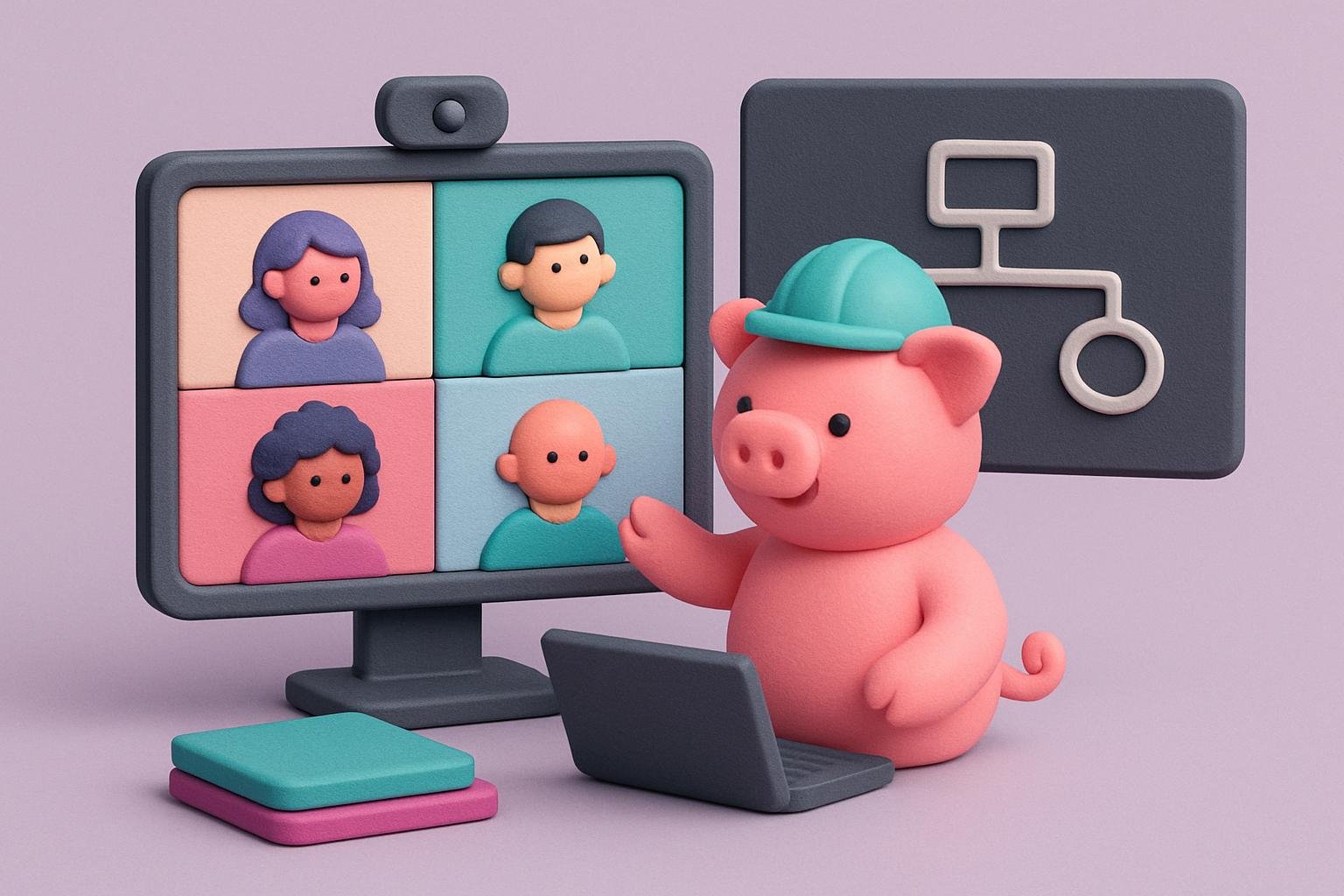
If we can’t be in the same physical space, at least we can see each other. Much of communication is nonverbal; we miss a lot when we can’t see each other’s actual faces.
You could use something like Zoom’s speaker view, where the speaker appears larger and everyone can see them easily. This makes the speaker the center of attention in that moment. It’ll help limit side conversations, and hopefully any attention that might otherwise have been wrongly directed at the Scrum Master will instead return to the developers.
Visualize the team’s data
As I mentioned earlier, remote daily Scrums have their advantages. You can easily share any visualizations that would be most useful to the team during the meeting. For example, share an image of your team’s burndown chart as team members join the meeting.
The Scrum Master doesn’t need to draw attention to it—just display it. The team can see its progress toward the sprint goal as they join the event. Many teams also find it useful to display their sprint backlog throughout the meeting. Then the discussion can focus on items in progress, rather than moving from person to person.
Get creative with how you communicate
The context of a remote meeting is very different from an in-person one. But you can develop a simple system to overcome the drawbacks of a remote environment. For example, many teams find it useful to communicate visually with cards when problems come up. Someone talking while muted? People can hold up their “You’re muted” cards.
Bandwidth problems? How about a “You’re frozen” card? As a Scrum-specific example, if someone is rambling in the daily Scrum, you can hold up an Elmo card.
E.L.M.O stands for “Enough, Let’s Move On.”
Use online tools to improve the meeting
Remember that much of the technology we use every day didn’t exist in 2001, when the Agile Manifesto was written. Keep the purpose of the daily Scrum in mind: to make a plan for the day.
Work. Then get creative about how you accomplish that goal. A spoken conversation is always better, but some teams use something like Slack instead, so the daily Scrum can be held asynchronously. Although using a tool started out as a replacement for the traditional daily meeting, some teams now prefer it to what they did before. Other tools, such as Range or Standuply, combine synchronous and asynchronous features to keep teams connected. Communication and collaboration are the goal. Content matters more than context, so let the developers decide how they prefer to collaborate.
Take the opportunity to “visit” each other’s homes
Also take advantage of the fact that people are joining from their homes to get to know each other better. Have everyone introduce their pets, children, and other important people to the group. Before each standup, hold short show-and-tells so team members can share something they care about without leaving home. Encouraging people to open up a little will go a long way toward creating a sense of psychological safety and trust within the team.
Above all, remember that we’re people who believe in inspection and adaptation. The way you ran the daily Scrum in person probably won’t work remotely. Instead of simply trying to convert what you did in person into a remote version, find what works best for the new paradigm we’re in now.